
Intercompany Eliminations · Track 5 · Tutorial 1 of 9
Eliminate trade receivables and payables
When one group company owes another, the receivable and the payable both sit in the group’s figures. They have to come out together, at every month end, whichever company’s books are in which currency.
1Know what to eliminate
At 31 October Company A shows SGD 48,000.00 on 1250 Due from Company B, and Company B shows AUD 51,400.00 on 2150 Due to Company A — SGD 46,054.40 at the closing rate of 0.8960.
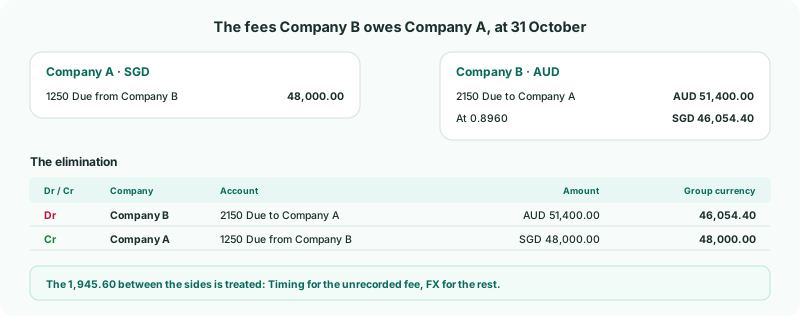
The two sides rarely agree: the rate moves, and one company books a charge before the other. Explaining that difference is most of the work — see Allocate a difference on a manual entry.
2Choose how to clear it
| If the accounts | Use | See |
|---|---|---|
| Hold only what the two companies owe each other, every month | A rule on Method 2, which takes both sides’ amounts and treats the difference | Method 2: use both amounts and treat the difference |
| Also hold outside customers and suppliers | An entry from the unpaid invoices and bills, reversed automatically the next month | Eliminate outstanding trade balances from documents |
| Hold a one-off balance | A GL entry | Post a GL elimination entry |
Your Group’s 1250 and 2150 hold nothing else, so a rule clears them.
3Know what the type accepts
Under Intercompany → Trade Receivables / Payables, an entry’s lines can use Accounts Receivable, Accounts Payable, Current Asset and Current Liability accounts. Sales and purchases go under Sales / Purchases / Services, and loans under Intercompany Loans.
A balance stays eliminated. An entry’s lines carry into later months like any balance. A rule eliminates each month’s movement, and an entry from documents is reversed the next month, so both keep up on their own. A GL entry doesn’t: in later months, enter only the change, or the balance is eliminated twice.
4Check the month
- Open the group’s Balance Sheet for October with Show Entities on.
Check
In the group column, the account 2150 is mapped to is zero. The account 1250 is mapped to is zero too, or shows only a timing difference you chose to leave — 1,840.00 for the fee Company B hasn’t recorded.
5If something goes wrong
| … cannot be used in this elimination type. | The account isn’t a receivable, payable or current account. Use the right type for it. |
|---|---|
| The balance is eliminated twice in a later month | A GL entry was repeated for the full balance. Enter only the month’s change, or use a rule or documents. |
| The difference keeps growing | It isn’t timing or exchange. Compare the two companies’ statements of account and correct the books. |
Want more detail? See the documentation