
Professional Services Groups · Track 2 · Tutorial 3 of 3
Consolidate an LLP into a corporate group
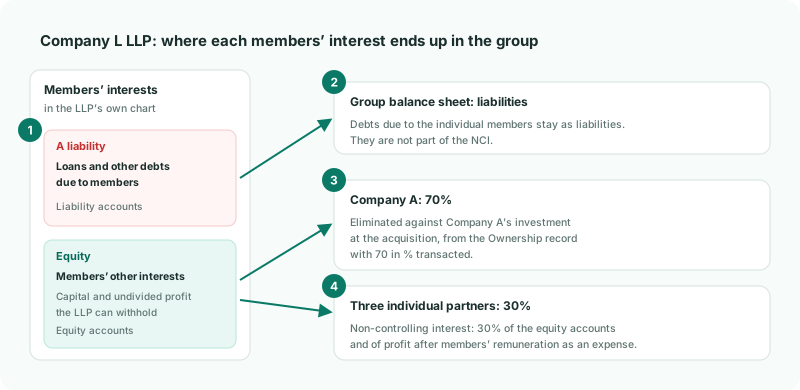
Many practices are LLPs, and a corporate group that controls one consolidates it like a company. What needs care is the members’ interests: some are debts, some are equity, and only the equity part is a non-controlling interest.
1Decide whether the LLP is a subsidiary
Company A, one of Your Group’s practice companies, is a corporate member of Company L LLP. It holds 70% of the members’ interests that are equity, and appoints the LLP’s management board. Three individual partners hold the other 30%.
An LLP the group controls is a subsidiary like a company (IFRS 10): it is consolidated line by line, and the individual members’ equity interests are a non-controlling interest. Its legal form doesn’t change that.
2Classify the members’ interests
Not everything the members put in or are owed is equity. Under IFRS, IAS 32 decides; under UK GAAP the LLP SORP applies the same test:
| Members’ interest | When |
|---|---|
| A liability | Capital the LLP must repay when a member leaves, and profit divided among the members automatically. In LLP accounts: Loans and other debts due to members, with the profit shown as Members’ remuneration charged as an expense. |
| Equity | Capital and undivided profit the LLP can withhold until the members decide to divide it: Members’ other interests. |
Only the equity part is in the NCI. Debts due to the individual members stay in the group’s balance sheet as liabilities.
3Put the classification in the LLP’s own chart
BrizoConsol takes the LLP’s equity from its own accounts of type Equity, both to eliminate it at the acquisition and to work out the NCI. Account Mapping doesn’t change that: a debt due to members held in an Equity account in the LLP’s chart is treated as equity, whatever group account it is mapped to.
- In the LLP’s accounting system, or its chart if it is loaded by upload, keep debts due to members in liability accounts, and members’ other interests in equity accounts.
- Load the month again.
- Open Settings → Global Settings → Account Mapping, and map the LLP’s accounts to group accounts of the same kind: debts due to members to a group liability account, members’ other interests to group equity, and members’ remuneration charged as an expense to its own group expense account.
4Record Company A’s interest
- Open Ownership & Equity → Ownership, and click Company L LLP under Group structure.
- Under Share purchases and sales, click + Record, then Bought shares.
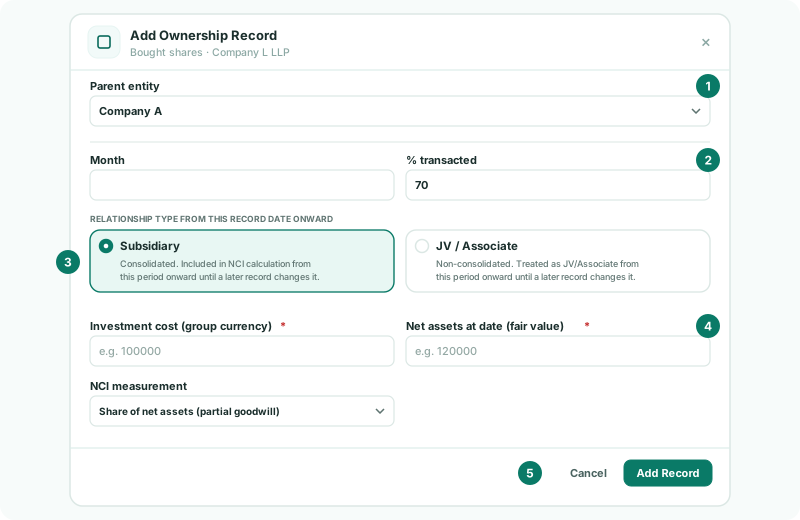
- Choose Company A as Parent entity, the month it became a member as Month, 70 in % transacted, and Subsidiary.
- Enter what Company A paid for its interest in Investment cost (group currency), and the LLP’s identifiable net assets at that date in Net assets at date (fair value). Click Add Record.
- Open Totals and accounts for this company, choose the investment and goodwill accounts, and click Save.
The percentage is Company A’s share of the LLP’s equity interests: an LLP has no shares. The NCI is then 30% of the LLP’s equity accounts and of its profit after members’ remuneration charged as an expense. If the members’ equity isn’t shared in that proportion, post the difference as a Consolidation journal of type NCI, with Company L LLP as Related company.
5Eliminate what flows between Company A and the LLP
Company A’s own share of profit divided to it as a debt, and anything it has lent the LLP, are intercompany: Company A has income and a receivable, the LLP an expense and a liability.
| Item | Where |
|---|---|
| Amounts lent and their interest | Under Intercompany → Intercompany Loans, as in Eliminate loans and interest. |
| Profit divided to Company A, and the balance it is owed | Under Intercompany → Other Eliminations, which accepts any accounts. See Use Other Eliminations. |
6Check the result
Check
On the Ownership page, Company L LLP shows an NCI % of 30.00%. On the group’s Balance Sheet with Show Entities on, the LLP’s members’ other interests are eliminated in the group column, the NCI is 30% of them, debts due to the individual members are in liabilities, and nothing due to or from Company A is left.
7If something goes wrong
| What you see | What to do |
|---|---|
| The NCI is larger than the individual members’ equity | A debt due to members is in an Equity account in the LLP’s chart. Change its type there and load the month again: mapping it to a liability isn’t enough. |
| Net assets at date (fair value) is required for the acquisition that establishes control. | Enter the LLP’s net assets at fair value at the date Company A took control. |
| Company A’s share of profit is still in the group’s figures | The profit divided to it isn’t eliminated. Add it under Other Eliminations. |
| Company L LLP isn’t consolidated | The record’s relationship is JV / Associate. Edit it to Subsidiary if Company A controls the LLP. |
Want more detail? See the documentation