
US GAAP Groups · Track 3 · Tutorial 3 of 4
Read the statement of changes in equity
Available on ProPremium
The US GAAP statement of changes in equity runs each component of stockholders’ equity, and the non-controlling interests, from the start of the year to the end. Every movement has a row; anything without one shows in Other, so you can see it and explain it.
1Know how the statement is built
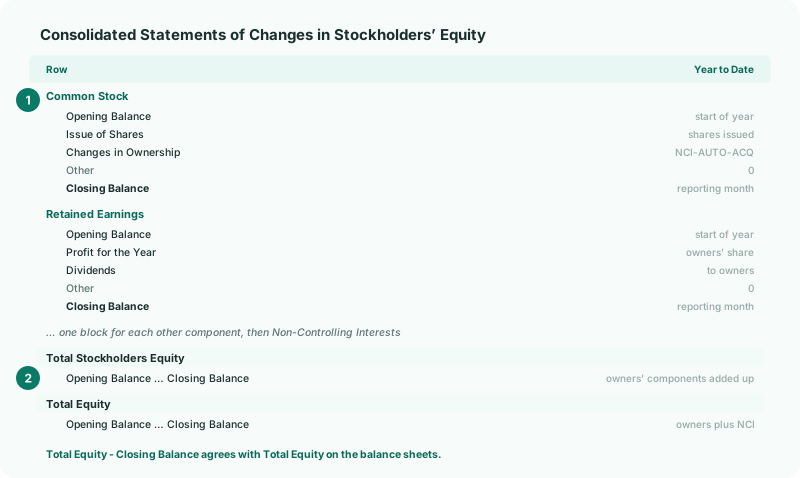
The statement has one column, Year to Date, and a block of rows for each component of equity. Every block runs the same way:
| Row | Read from |
|---|---|
| Opening Balance | The component at the end of the previous financial year. |
| Profit for the Year | The year’s net income: the owners’ share under Retained Earnings, the NCI’s share under Non-Controlling Interests. |
| Other Comprehensive Income | The AOCI component’s movement, as on the statement of comprehensive income. For Non-Controlling Interests, its share of the CTA and of the other reserves. |
| Dividends | Accounts classified on the CF tab as Dividends Paid under Retained Earnings, and as Payments to Non-Controlling Interests under Non-Controlling Interests. |
| Issue of Shares | Accounts classified on the CF tab as Proceeds from Issuance of Common Stock, under Common Stock. |
| Changes in Ownership | BrizoConsol’s own entries for buying and selling shares in subsidiaries, the journals starting NCI-AUTO-ACQ. |
| Other | Whatever moved the component that none of the rows above explains. It should be zero. |
| Closing Balance | The component at the end of the reporting month: the same date as the balance sheets. |
A block appears only for the rows that apply to it: Additional Paid-in Capital has no Dividends row, an AOCI component has only Other Comprehensive Income. Under the components, two blocks add them up the same way: Total Stockholders Equity, and Total Equity, which adds Non-Controlling Interests.
2Read the components
- Select Your Group, and open Reports → All Reports → Consolidated Statements of Changes in Stockholders’ Equity for 2026.
| Component | What usually moves it |
|---|---|
| Common Stock, Additional Paid-in Capital | Stock issued in the year, and BrizoConsol’s ownership entries. |
| Treasury Stock | The group’s own shares bought back or reissued. There is no row of its own for it, so a movement shows in Other. |
| Retained Earnings | The owners’ share of the year’s net income, less dividends to the owners. |
| Foreign Currency Translation Adjustment, Unrealised Gains/Losses on Securities, Pension Adjustments, Cash Flow Hedge Gains/Losses, Share of OCI of Associates | The year’s OCI on each — the same figures as the statement of comprehensive income. |
| Equity Transaction Reserve | The difference when the group buys or sells shares in a subsidiary it keeps control of. |
| Acquisition Accounting Adjustment | Listed for every group; shows a figure only if an account is classified on it. |
| Non-Controlling Interests | The NCI’s share of net income and OCI, payments to it, and changes in the group’s holdings. The NCI Report shows the same movements for each subsidiary. |
Profit for the Year appears twice, once for the owners and once for the NCI. In the Total Equity block the two add back to Net Income on the US GAAP profit and loss.
3Clear anything in Other
A figure in a component’s Other row is a movement the statement has no line for. It is shown so the block still reaches its closing balance, not hidden in another row.
| Usual cause | Fix |
|---|---|
| A dividend booked straight to retained earnings, with no dividends account | Book dividends to their own account, and classify it on the CF tab as Dividends Paid. |
| Stock issued to an account not classified as Proceeds from Issuance of Common Stock | Classify that account on the CF tab. |
| A transfer between reserves, or a correction posted to equity | Expected: it has no line of its own. Note it in the year-end pack. |
| Treasury stock bought back | Expected for Treasury Stock. |
4Tie it to the other statements
- Open Consolidated Balance Sheets at the same month.
- Open Consolidated Statements of Comprehensive Income for the same year.
- Open the statement of changes in equity for the year before.
Check
Total Equity - Closing Balance equals Total Equity on the balance sheets, and Total Stockholders Equity - Closing Balance equals Total Stockholders’ Equity there. Total Equity - Profit for the Year equals Net Income, and Total Equity - Other Comprehensive Income equals Other Comprehensive Income, on the statement of comprehensive income. Each Opening Balance equals last year’s Closing Balance. Every Other row is zero, or explained.
5If something goes wrong
| A component is zero, but the account has a balance | The account isn’t on its equity line. Classify it on the Equity tab of the Accounting Standard page. |
| Dividends are in Other instead of Dividends | The dividend account isn’t classified on the CF tab. Classify it as Dividends Paid, or as Payments to Non-Controlling Interests. |
| Issue of Shares is zero after a stock issue | 3000 Share Capital isn’t on Proceeds from Issuance of Common Stock. Add it on the CF tab; it keeps its Common Stock line. |
| Opening Balance is zero | Last year’s figures aren’t loaded for the group’s companies. |
| Opening Balance differs from last year’s Closing Balance | Last year’s figures changed after last year’s statement was produced, for example a reloaded month or a late journal. |
Want more detail? See the documentation