
SaaS & Technology Groups · Track 3 · Tutorial 2 of 2
Read each company’s margin after IP royalties
A royalty to the IP company shifts profit between your companies, so no company’s own margin shows how its business is doing. Reading each margin before and after the royalty, next to the group’s, does.
1Know why each company’s margin moves
The IP company charges each operating company a royalty for the software, at a rate set for tax and transfer pricing. The royalty moves profit from the operating companies to the IP company, but not out of the group:
| Operating companies | Their margin is after a cost the group doesn’t pay. |
|---|---|
| IP company | Its margin includes income the group doesn’t earn. |
| The group | Both sides are eliminated, so its margin is unaffected by the royalty rate. |
Read each company’s margin both ways: after royalties, as its books show it, and before, to see how the business it runs performs.
2Put the royalty on the same line in every company
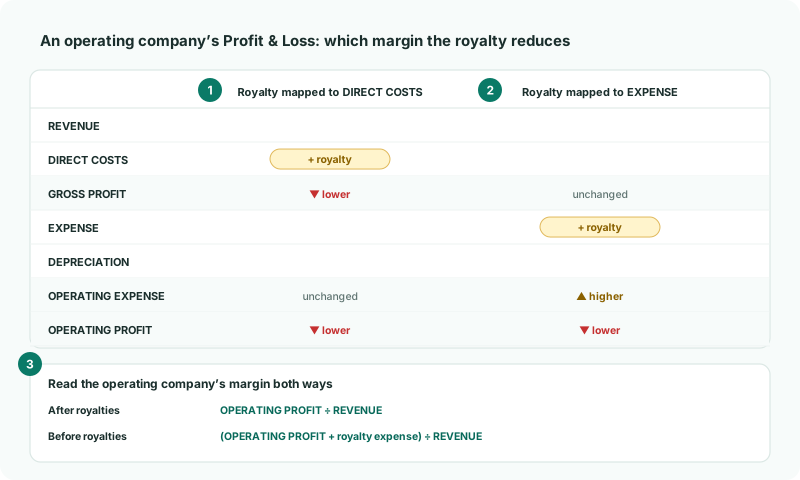
Where the royalty is mapped decides which margin it reduces:
| Mapped to | Reduces |
|---|---|
| DIRECT COSTS | GROSS PROFIT and OPERATING PROFIT |
| EXPENSE | OPERATING PROFIT only |
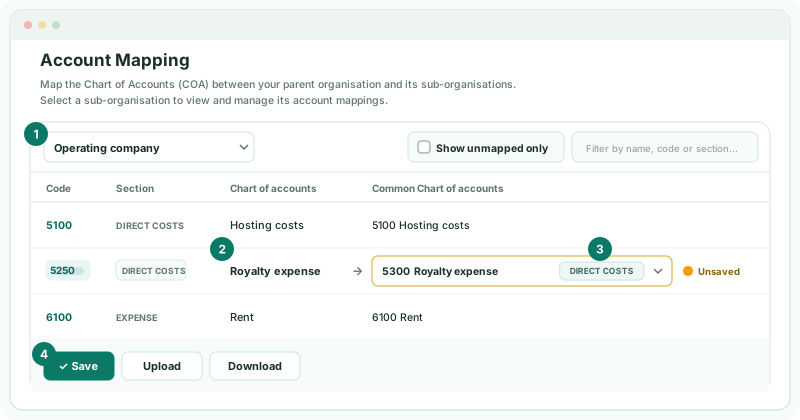
On Settings → Global Settings → Account Mapping, map every operating company’s royalty expense to the same group account, and the IP company’s royalty income to a REVENUE account of its own, so the margins can be compared.
3Lay the companies side by side
- Select Your Group, and open Reports → Profit & Loss for Oct-2026.
- Turn on Show Entities.
Each company has a column, then Elims/Adj and the group. The royalty is a cost in each operating company’s column and income in the IP company’s, and both are taken out in Elims/Adj, as in Eliminate platform fees between companies in different currencies.
4Read the margins
| Margin | Read it as |
|---|---|
| Operating company, after royalties | Its OPERATING PROFIT ÷ its REVENUE, as the report shows them. |
| Operating company, before royalties | (Its OPERATING PROFIT + its royalty expense) ÷ its REVENUE. |
| IP company, before royalties | Its OPERATING PROFIT less its royalty income: what owning and developing the software costs the group. |
| The group | Its OPERATING PROFIT ÷ its REVENUE in the group column, with no royalty in either. |
If an operating company’s margin before royalties is healthy and after royalties is thin, the royalty rate is doing what it was set to do; the business itself is sound. If it is thin both ways, the problem is the business, not the royalty.
Check
In the group column the royalty lines are empty, and on OPERATING PROFIT the company columns plus Elims/Adj equal the group.
5If something goes wrong
| What you see | What to do |
|---|---|
| The royalty is still in the group column | It isn’t eliminated, or only partly. Check the rule and Elimination Review for the month. |
| One operating company’s gross margin is much higher than the others’ | Its royalty is mapped to EXPENSE and the others’ to DIRECT COSTS. Map them all to the same group account. |
| A foreign company’s figures don’t match its books | They are translated into the group currency. Compare its margin, not its amounts, with its own report. |
Want more detail? See the documentation