
Professional Services Groups · Track 2 · Tutorial 1 of 3
Account for an earn-out on an acquisition
Practices are often bought with part of the price paid later, if the fees hold up. The earn-out is part of the price at its fair value on the day, and later changes in its value go to profit, not to goodwill.
1Know the treatment
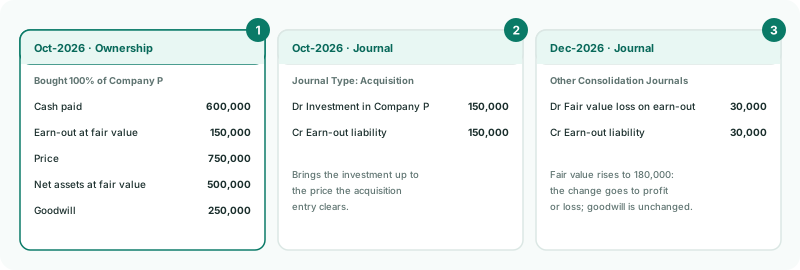
In October 2026, Your Group buys 100% of Company P, an advisory practice, for SGD 600,000 in cash now, plus up to 300,000 in 2028 if the practice’s fees reach a target: an earn-out. A valuer puts the earn-out’s fair value at 150,000, and the practice’s identifiable net assets at 500,000. The figures are illustrative.
| At the acquisition | The consideration includes the earn-out at its fair value at the acquisition date (IFRS 3.39): 600,000 + 150,000 = 750,000. Goodwill is 750,000 − 500,000 = 250,000. |
|---|---|
| Afterwards | An earn-out to be paid in cash is a liability. Changes in its fair value go to profit or loss, and goodwill isn’t changed (IFRS 3.58). |
| Paid only if the sellers stay | An earn-out the sellers lose if they leave is pay for their work after the acquisition, not part of the price (IFRS 3.B55). It is an expense in the practice’s results: leave it out of the steps below. |
2Record the acquisition at the full price
- Open Ownership & Equity → Ownership, and click Company P under Group structure.
- Under Share purchases and sales, click + Record, then Bought shares.
- Choose Your Group as Parent entity, Oct-2026 as Month, and enter 100 in % transacted. Choose Subsidiary.
- Enter 750,000 in Investment cost (group currency): the cash and the earn-out’s fair value together.
- Enter 500,000 in Net assets at date (fair value), and click Add Record.
- Open Totals and accounts for this company, choose Investment in subsidiary - Company P and Goodwill - Company P, and click Save.
BrizoConsol has no field of its own for an earn-out: it is part of the investment cost. See Record an acquisition and its acquisition details for the rest of the record.
3Add the earn-out to the investment
The acquisition entry clears the investment with the whole 750,000. If Your Group’s own books record only the 600,000 paid, the investment would be left 150,000 short, and the earn-out liability would be missing. Add both at group level:
- Open Adjustments → Consolidation Journals, and choose Oct-2026.
- Click + Add a new journal entry. Enter the Journal ID EO-P-2026-10, and choose Acquisition as Journal Type.
- Enter the Description Earn-out on acquisition of Company P at fair value.
- Debit 1610 Investment in Company P 150,000, credit 2450 Earn-out liability 150,000, and click Confirm.
The liability account needs to be in your Common COA, as a liability. If Your Group’s own books already include the earn-out in the investment, skip this step.
4Remeasure it at each reporting date
At 31 December 2026 the valuer puts the earn-out at 180,000. Post the change, 30,000:
- In Adjustments → Consolidation Journals, choose Dec-2026 and click + Add a new journal entry.
- Enter the Journal ID EO-P-2026-12, and keep Other Consolidation Journals as Journal Type.
- Debit your profit and loss account for the change, such as 7300 Fair value loss on earn-out, 30,000, credit 2450 Earn-out liability 30,000, and click Confirm.
Post only the change since the last remeasurement: the earlier journals stay in later months. A fall in fair value runs the other way, as a gain. When the earn-out is paid, the payment should clear the liability: if Your Group’s own books post it to another account, such as the investment, move it to the liability with another Other Consolidation Journals entry.
If, within twelve months of the acquisition, new information about facts at the acquisition date changes the earn-out’s fair value at that date, that is a correction of the price, not a remeasurement: edit the record’s Investment cost and the October journal, and goodwill is worked out again.
5Check the result
Check
On the Ownership page, Company P’s record shows Price 750,000, Net assets at fair value 500,000 and Goodwill 250,000. On the group’s Balance Sheet for October with Show Entities on, Investment in Company P is zero in the group column, goodwill is 250,000 and the earn-out liability 150,000. December’s Profit & Loss shows the 30,000 loss, and goodwill is still 250,000.
6If something goes wrong
| What you see | What to do |
|---|---|
| Investment cost is required for acquisition. | Enter the price, including the earn-out. |
| Net assets at date (fair value) is required for the acquisition that establishes control. | Enter the net assets at fair value from the purchase price allocation. |
| Investment in Company P is −150,000 in the group column | The October Acquisition journal is missing. |
| Investment in Company P is 150,000 in the group column | The earn-out is in both Your Group’s books and the journal. Delete the journal. |
| Choose the NCI net assets and share of profit accounts to see what posts. | Click the Posting accounts icon beside Group structure, choose NCI - net assets and NCI - share of profit, and click Save. They are needed even for a company owned 100%. |
| Debit and Credit totals must be balanced before saving. | Check the journal’s amounts until the Difference is zero. |
Want more detail? See the documentation