
Ownership and NCI · Track 2 · Tutorial 1 of 4
Read the acquisition entries line by line
An acquisition posts one balanced entry, dated in the month the group took control. It takes the company’s equity at that date out of the group accounts, replaces the investment with goodwill and the NCI, and keeps profit made before the purchase out of the group’s profit. Read it line by line, and you can tie every figure to the purchase price allocation.
1Know the figures
Your Group bought 80% of Company F in September 2026 for 960,000. Company F’s financial year runs January to December. At the date of the purchase, its books show:
| Share capital | 500,000 |
|---|---|
| Retained earnings | 300,000, brought forward from earlier years |
| Profit January to August 2026 | 120,000 |
| Book equity | 920,000 |
The purchase price allocation values its identifiable net assets at 1,000,000: 80,000 more than its books. The NCI is measured at its share of the net assets, 200,000.
2Open the acquisition on the NCI Report
- Open Ownership & Equity → NCI Report.
- Choose Actual as Scenario, YTD as Basis and Sep-2026 as As at period.
- In NCI movement by subsidiary, click Company F’s row, and open How each figure was worked out in its card.
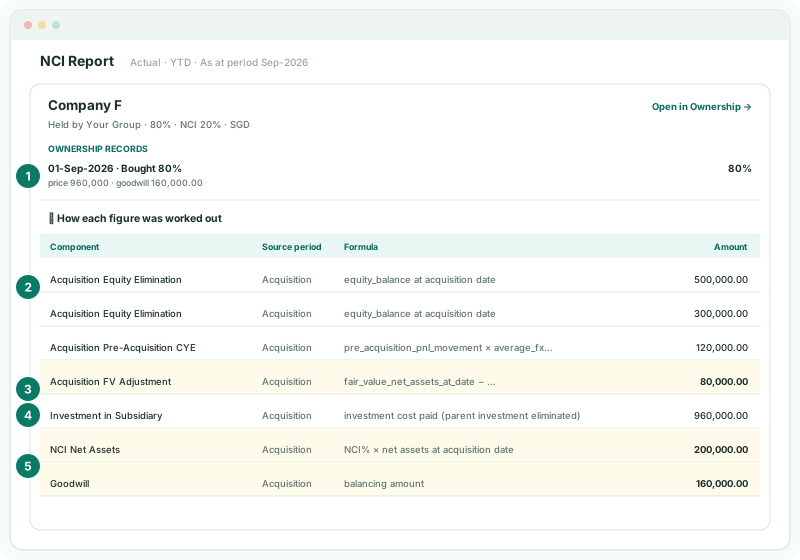
The card’s heading repeats the holding: Held by Your Group · 80% · NCI 20% · SGD. Under Ownership records, the record reads 01-Sep-2026 · Bought 80%, with its price and goodwill. In How each figure was worked out, the rows whose Source period is Acquisition are the acquisition entry. The rows for later months are the NCI’s share of profit, covered in Read the NCI Report month by month.
3Read the equity eliminated
| Component | Formula | Amount |
|---|---|---|
| Acquisition Equity Elimination | equity_balance at acquisition date, one row for each equity account | Share capital 500,000; retained earnings 300,000 |
| Acquisition Pre-Acquisition CYE | pre_acquisition_pnl_movement × average_fx (monthly), one row for each profit and loss account | Together 120,000 |
The group bought Company F’s equity as it stood in September, so all of it is eliminated: at 100%, not 80%. The NCI’s part comes back as its own line in step 6.
The profit Company F made from January to August is part of what the group bought, not profit the group earned. So it is taken out of the group’s profit and loss account by account, and the group’s year to date only includes Company F from September. For a company in another currency, each month is translated at that month’s average rate, and the equity at the closing rate on the date.
4Read the fair value adjustment
Acquisition FV Adjustment is the difference between the net assets at fair value and what was eliminated: its formula is fair_value_net_assets_at_date - translated_source_equity_at_acquisition_date - pre_acquisition_cye.
1,000,000 − 800,000 − 120,000 = 80,000, posted to the FV Adjustment account, a non-current asset. It is what brings the eliminated amount up to the fair value goodwill is measured from. When the fair value equals the books, there is no row.
5Read the investment
| Component | Formula | Amount |
|---|---|---|
| Investment in Subsidiary | investment cost paid (parent investment eliminated) | 960,000 |
Your Group recorded the purchase in its own books: the 960,000 is already in Investment in subsidiary - Company F, and the cash has already left its bank. On consolidation the investment is replaced by what it bought, so this row credits the investment with the cost and clears it. Nothing is posted to the bank.
6Read the NCI and the goodwill
| Component | Formula | Base | NCI % | Amount |
|---|---|---|---|---|
| NCI Net Assets | NCI% × net assets at acquisition date | 1,000,000 | 20.00% | 200,000 |
| Goodwill | balancing amount | 160,000 |
The NCI starts at its 20% of the fair value. Goodwill is what balances the entry: 960,000 + 200,000 − 1,000,000. If the balance went the other way, the row would be Gain on Bargain Purchase instead.
7Put the entry together
| Account | Debit | Credit |
|---|---|---|
| Company F’s share capital and retained earnings | 800,000 | |
| Company F’s profit and loss accounts, January to August | 120,000 | |
| FV Adjustment | 80,000 | |
| Goodwill - Company F | 160,000 | |
| Investment in Company F | 960,000 | |
| NCI - net assets | 200,000 | |
| Total | 1,160,000 | 1,160,000 |
- Open Review → Elim. & Journals Report for Sep-2026, and search for NCI-AUTO-ACQ.
- Open Auto NCI acquisition-date posting Company F (ACQUIRE).
Its lines carry the same amounts, each with a description that names it: Auto NCI acquisition equity elimination - Company F, Auto NCI acquisition pre-acquisition current year earnings, Auto NCI acquisition FV adjustment - Company F, Auto NCI investment in subsidiary, Auto NCI net assets and Auto NCI goodwill.
8Check the preview balances
- On Ownership & Equity → Ownership, click Company F, and open What posts for the current month.
Check
Under Summary & Calculation Details, Debit total equals Credit total and Balanced is Yes. On Reports → Balance Sheet for Sep-2026 with Show Entities on, Company F’s share capital is eliminated in the group column, and on Reports → Profit & Loss for Sep-2026 YTD, Company F’s January to August profit isn’t in the group total.
The preview also explains how the later NCI is worked out, under Reserve Base Calculation: net assets from the subsidiary’s closing equity at the closing rate, share of profit from the year’s profit and loss at the average rate, and share of CTA and of other reserves at the closing rate.
9If something doesn’t tie
| What you see | What to do |
|---|---|
| The FV adjustment is larger than the valuation’s uplift | Company F’s balances for the months up to the purchase aren’t all loaded, so less equity is eliminated. Load them and check again. |
| Group profit includes Company F before September | The record’s month is earlier than September. Edit the record. |
| An equity account isn’t eliminated | Company F’s account isn’t mapped to a group equity account. Check its mapping. |
| The goodwill differs from the purchase price allocation | Check the price, the net assets at fair value and the NCI on the record. All are in the group currency. |
| No acquisition rows | The record is on hold for a missing figure, or the company has an amber dot on the Ownership page. See Record an acquisition and its acquisition details. |
Want more detail? See the documentation