
Multi-level groups · Track 2 · Tutorial 1 of 5
Follow the NCI through each level
Available on ProPremium
When a company is held through another company, its NCI is shared between the levels above it. Each level’s statements carry the part that is outside that level, and the parts add up to the group’s NCI.
1Know the percentages
In the running example, Your Group holds 80% of Holdco UK, and Holdco UK holds 70% of UK Sub. Holdco UK has its own minority shareholders, with the other 20%.
| Holdco UK | Group % 80%, NCI % 20%. |
|---|---|
| UK Sub | Direct 70%, held by Holdco UK. Group % 80% × 70% = 56%, NCI % 44%. |
2Know which level carries which part
Each level’s statements consolidate what is under it, and measure it from that level. Holdco UK holds 70% of UK Sub, so on Holdco UK’s statements 30% of UK Sub is outside: that is NCI there. On Your Group’s statements 44% of UK Sub is outside. Your Group’s statements include Holdco UK’s, with its 30%, so Your Group adds the other 14%: Holdco UK’s minority’s 20% of the 70%.
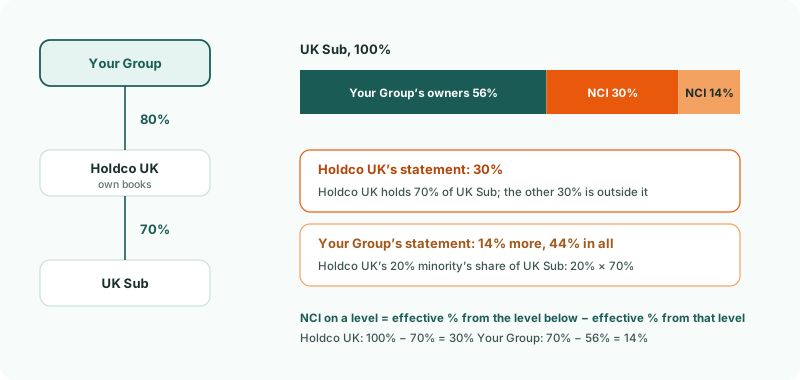
| Holdco UK | 30% of UK Sub. |
|---|---|
| Your Group | 14% of UK Sub, and 20% of Holdco UK’s own figures. |
| Asia Pacific | 10% of Company B. A group has no ownership record of its own, so it counts as wholly owned: all of Company B’s NCI is on Asia Pacific, and none is added on Your Group. |
Added up over the levels, each company’s NCI is its NCI % on the group: 30% + 14% = 44% for UK Sub.
3Read the acquisition on Holdco UK
In October 2026, Holdco UK buys 70% of UK Sub for 900,000, when UK Sub’s identifiable net assets are 1,000,000 at fair value (figures in SGD). The acquisition entry is posted on Holdco UK, the level that consolidates UK Sub:
| Investment eliminated | 900,000, Holdco UK’s cost. |
|---|---|
| Goodwill | 900,000 − 70% × 1,000,000 = 200,000. |
| NCI at the date | 30% × 1,000,000 = 300,000: UK Sub’s other shareholders. |
So Holdco UK’s balance sheet has no investment in UK Sub, and shows the goodwill and the NCI. Your Group’s includes the same entry. Holdco UK’s minority isn’t credited at the date: Hold companies through other companies explains why.
4Share the profit
In November, UK Sub makes a profit of 100,000, and Holdco UK makes 50,000 in its own books. The NCI’s share is posted in parts:
| NCI share | Amount | Posted on |
|---|---|---|
| UK Sub, 30% | 30,000 | Holdco UK |
| UK Sub, 14% | 14,000 | Your Group |
| Holdco UK, 20% | 10,000 | Your Group |
The NCI’s share of the CTA, and of net assets and other reserves, is split between the levels the same way.
5Find each part on NCI Reconcile
- Select Your Group.
- Open Ownership & Equity → NCI. The page is titled NCI Reconcile / Verify.
- Choose Actual as Scenario, and Nov-2026 as Period.
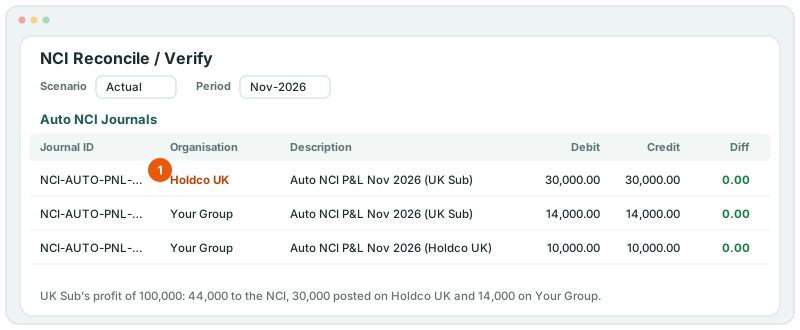
Organisation names the level each journal is posted on. Opened on Your Group, the page lists every level’s journals, so you reconcile the whole group in one place. Click a row to see its lines.
Check
Under Auto NCI Journals, Auto NCI P&L Nov 2026 (UK Sub) is listed twice: 30,000.00 on Holdco UK and 14,000.00 on Your Group. Every Diff is 0.00. On Ownership & Equity → NCI Report, UK Sub’s NCI % is 44%.
6If something goes wrong
| What you see | What to do |
|---|---|
| All of UK Sub’s NCI is on Your Group | UK Sub isn’t under Holdco UK in the Organisation Hierarchy. Move it there and save. |
| UK Sub’s NCI is 30% in all | Its record’s Parent entity is Your Group. Edit it and choose Holdco UK. |
| A journal on Holdco UK has a red Diff | Open it and read its lines. An auto journal is posted again at each recalculation, so correct its cause — an ownership record, an account — rather than the journal. |
Want more detail? See the documentation