
Ownership and NCI · Track 2 · Tutorial 4 of 4
Hold companies through other companies
When a subsidiary buys a company of its own, the group’s share of that company is the product of the percentages along the chain. The minority shareholders of the company in the middle own part of everything below it, so the NCI of the company at the bottom is larger than its direct record suggests. You record only the direct purchase; BrizoConsol follows the chain.
1Know the three percentages
Your Group owns 80% of Company F. In October 2026, Company F buys 60% of Company M for 70,000, when Company M’s identifiable net assets at fair value are 100,000. Company M reports in SGD, like the group.
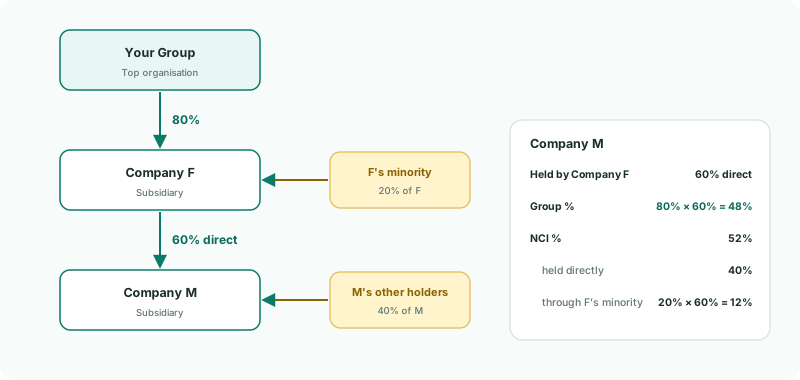
| Direct | What Company M’s direct parent, Company F, holds: 60%. |
|---|---|
| Group % | What Your Group holds through the chain: 80% × 60% = 48%. |
| NCI % | Everyone else: 52%. That is 40% held directly by Company M’s other shareholders, and 12% — 20% of Company F’s 60% — held by Company F’s minority. |
Company M is still a subsidiary, consolidated line by line. Control passes down the chain: Your Group controls Company F, and Company F controls Company M.
2Record the purchase against the direct parent
- Open Ownership & Equity → Ownership, and click Company M in Group structure.
- Beside Share purchases and sales, click + Record, then Bought shares.
- Choose Company F as Parent entity — not Your Group — then Oct-2026, 60 and Subsidiary.
- Enter the Investment cost (group currency), 70,000, and the Net assets at date (fair value), 100,000. Click Add Record.
- Under Totals and accounts for this company, choose Investment in subsidiary - Company M — the group account Company F’s investment is mapped to — and Goodwill - Company M, and click Save.
The Parent entity list has Your Group, marked as the top organisation, and every other company in the group. The record holds only what Company F bought. Don’t enter 48%: BrizoConsol works that out from Company F’s own records.
3Read the chain on the Ownership page
In Group structure, Company M sits under Company F. Click it, and its figures read:
| Held by | Company F, 60% direct |
|---|---|
| Group % | 48%, with the working under it: 80% × 60% = 48%, Company F’s group % times Company M’s direct %. |
| NCI % | 52% |
The posting uses the same 48%. Under Company M’s Totals and accounts for this company, Direct ownership % is 60% (held by direct parent) and Effective group % is 48% (through ownership chain).
4Read the acquisition: goodwill on the direct purchase
Company F paid for its 60%, so goodwill and the NCI at the date are measured on that direct purchase:
| Goodwill | 70,000 − 60% × 100,000 = 10,000 |
|---|---|
| NCI at the date | 40% × 100,000 = 40,000: Company M’s other shareholders |
| Investment eliminated | 70,000, at Company F’s cost |
Company F’s minority isn’t credited here. Their 20% of Company F already includes 20% of Company F’s 70,000 investment in Company M: 14,000, which stays in Company F’s own NCI. Crediting them again in Company M’s entry would count it twice.
5Share the profit after the purchase
From the purchase, the NCI takes 52% of Company M’s results: its direct 40%, and Company F’s minority’s 12%.
| Company M, November and December | Amount |
|---|---|
| Profit | 10,000 |
| NCI share, 52% | 5,200 |
| Owners of Your Group, 48% | 4,800 |
| NCI in Company M at the year end | 40,000 + 5,200 = 45,200 |
The NCI’s share of Company M’s net assets is the part held at the purchase, at the direct 40%, plus the movement since, at 52%. Measuring the whole 110,000 at 52% would give Company F’s minority a share of net assets they bought through Company F, not out of the group.
6Know what happens when the chain changes
A purchase or sale of Company F changes the group’s share of Company M as well, though Company M’s own record doesn’t change. If Your Group buys the rest of Company F, Company M’s effective group % becomes 60% and its NCI 40%, and Company M’s profit is shared at 40% from the month of the purchase. Record the change on Company F, not Company M.
Company F’s minority also owned 12% of Company M, through Company F. When Your Group buys them out, that part of Company M’s NCI is bought too: the entry for the purchase of Company F takes it out of NCI with Company F’s own NCI, and the difference from the price goes to the equity transaction reserve. See Set up the NCI accounts for the reserve.
7Check the result
- Open Ownership & Equity → NCI Report for YTD, Dec-2026, and click Company M’s row.
Check
The card’s heading describes Company F’s purchase: Held by Company F · 60% · group 48% · NCI 52%. Under How each figure was worked out, the acquisition rows show goodwill of 10,000 and NCI Net Assets of 40,000, and the NCI Share of Profit row applies 52.00% to Company M’s profit. Company F’s row still shows an NCI % now of 20%.
8If something goes wrong
| What you see | What to do |
|---|---|
| Company M’s effective % equals its direct % | The record’s Parent entity is Your Group. Edit it and choose Company F. |
| Goodwill looks too large | The investment cost is Company F’s price for its 60%, and the net assets are Company M’s whole net assets. Check both. |
| Company M’s NCI didn’t change after a change in Company F | Check the change is recorded under Company F’s Share purchases and sales, with the right month. |
| Company M has an amber dot | Open it, and click Choose beside what it Needs. |
Want more detail? See the documentation