
Intercompany Eliminations · Track 1 · Tutorial 1 of 5
Plan your intercompany items
Every setting in this track follows from one list: what your companies book between themselves, on which accounts, and how often. Write that list first. It decides which intercompany types you switch on, how the accounts should be named and mapped, and which items a rule can clear on its own.
1See what the plan decides
An intercompany item is anything one company in the group books against another: a fee, a sale, a loan, a balance still owed. Each company books its side correctly, but added together both sides land in the group’s figures, so every item must be eliminated. Your plan answers four questions for each one:
| Question | What it sets up | Where |
|---|---|---|
| What kind of item is it? | The intercompany type, and with it the place in the Intercompany menu | Switch on and add intercompany types |
| Which account does each company use? | The account pair a rule or an entry eliminates | Name and map intercompany accounts |
| Does it recur on the same accounts? | Whether a rule can clear it every month | The Automate with rules track |
| Do those accounts also hold outside business? | Whether it must be cleared from invoices and bills instead | The Eliminate by hand track |
2List every item
Go through each company’s chart of accounts and its last few months of transactions with the person who keeps its books. For every item booked against another group company, write down:
| The item | In plain words: the monthly management fee, goods sold, a loan. |
|---|---|
| From side | The company that charges, sells, lends or is owed, and the account it books to. |
| To side | The other company, and the account it books to. |
| How often | Every month, now and then, or once. |
| Shared account? | Whether either account also holds amounts with customers or suppliers outside the group. |
Look in both directions. A balance owed is two items: the charge that created it, and the receivable and payable it leaves behind until it is paid.
3Give each item a type
BrizoConsol has eleven intercompany types. Each has its own entry in the Intercompany menu, so the type is how your team finds an item later. Four are switched on for a new group, and Other Eliminations is always on:
| Type | Use it for | New group |
|---|---|---|
| Trade Receivables / Payables | Outstanding balances between group entities. | On |
| Sales / Purchases / Services | Internal goods sales, services and the matching costs, whether paid or not. | On |
| Inventory Transfers | Intercompany inventory sales and purchases. | On |
| Unrealised Profit | Profit in inventory not yet sold outside the group. | Off |
| Intercompany Loans | Loans, interest and funding balances. | Off |
| Management Charges | Management fees and shared service charges. | On |
| Dividends | Dividend income and distributions between group companies. | Off |
| Fixed Assets | Gains and adjustments from fixed assets moved between companies. | Off |
| Rental / Lease Adjustments | Rental and lease adjustments made by hand from lease schedules, not from invoices alone. | Off |
| Other Income / Expenses | Other intercompany income and expenses. | Off |
| Other Eliminations | Anything that fits none of the above. | Always on |
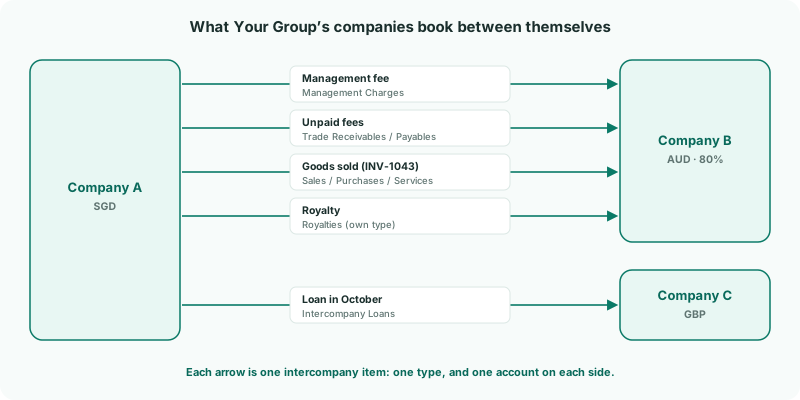
If your team wants an item listed under its own name, plan a type of your own that works like one of these. Your Group does this for Company A’s royalty, which works like a management charge but is reported on its own.
4Decide how each item is cleared
| Clear it with | When |
|---|---|
| A rule | The item recurs, each side always uses the same account, and those accounts hold nothing but this item. The rule then clears it every month without anyone touching it. |
| A GL entry | A one-off, or an item a rule does not cover. You enter the companies, accounts and amounts yourself. |
| A document entry | The account also holds outside business, so only some invoices and bills are intercompany. You pick those documents and the entry is built from them. |
Note too where the two companies keep their books in different currencies. Their sides will differ once translated into the group currency, and each rule or entry for that pair will need to say how to treat the difference. Company A is in SGD, Company B in AUD and Company C in GBP, so every item in Your Group’s plan crosses a currency.
5Write the plan down
Your Group’s plan:
| Item | Type | From side | To side | Cleared by |
|---|---|---|---|---|
| Monthly management fee | Management Charges | Company A — 4900 Management fee income | Company B — 6420 Management fees | A rule |
| Unpaid fees | Trade Receivables / Payables | Company A — 1250 Due from Company B | Company B — 2150 Due to Company A | A rule |
| Royalty | Royalties, a type of your own | Company A — its royalty income | Company B — its royalty expense | A rule |
| October loan | Intercompany Loans | Company A — 1300 Loan to Company C | Company C — 2400 Loan from Company A | A GL entry |
| Goods sold, INV-1043 | Sales / Purchases / Services | Company A — 4000 Sales | Company B — 5000 Purchases, BILL-778 | A document entry: 4000 Sales also holds sales to outside customers |
Keep the plan with your month-end notes. When a company starts a new kind of intercompany business, add a row before the first month it is booked.
Check
Every item has one type, one account on each side, and a way to clear it. Every company that books an intercompany item appears in at least one row.
6If something goes wrong
| The two companies give different amounts for the same item | One has booked something the other has not yet, or at a different rate. Note it: it is the difference a rule or an entry will have to treat. |
| One side uses several accounts for the same item | A rule reads whole accounts. Ask that company to book the item to one account, or plan to clear it by hand. |
| An item fits two types | Choose the one your team will look under. The type changes where the item is listed, not the amount eliminated. |
| Nobody knows the other side’s account | Ask the other company’s bookkeeper before you build a rule. A rule with a wrong account eliminates the wrong figures every month. |
Want more detail? See the documentation