
Intercompany Eliminations · Track 1 · Tutorial 4 of 5
Name and map intercompany accounts
A rule pairs one company’s account with another’s, and BrizoElim and COA Suitability find those pairs by reading the accounts’ names. Then each side has to land on its own group account, or there is nothing to eliminate. Get both right once and every later step in this series is easier.
1See what reads the account names
| What | What it looks for |
|---|---|
| COA Suitability | Pairs whose names say they are intercompany and name each other’s company. It decides whether your chart suits recurring rules. |
| BrizoElim | The same pairs, to suggest rules and find missing eliminations. It also reads the names to suggest a type for each pair. |
| You, in a rule | Choosing the right account on each side is quick when the name says what it is and with whom. |
BrizoConsol takes each account’s code, name, description and type from the company’s own books. So the names are changed in the company’s accounting system, and reach BrizoConsol the next time that company is loaded.
2Give each other company its own account
In each company’s books, keep intercompany items apart from outside customers and suppliers, and use one account per other company:
| Instead of | Use | Why |
|---|---|---|
| Company A’s fees due from Company B in its trade debtors | 1250 Due from Company B | A rule reads the whole account. Mixed with outside debtors, it would eliminate those too. |
| One “Loans to group companies” for every borrower | 1300 Loan to Company C, and a separate Loan to Company F if Company A lends to it | Each pair of companies needs its own pair of accounts, or the rule cannot tell whose balance is whose. |
Where an item cannot have its own account — Company A’s goods sales to Company B go to 4000 Sales with its outside sales — plan to clear it from invoices and bills instead, as in your plan.
3Name both sides for intercompany and for the other company
BrizoConsol counts two accounts as a reliable pair only when they pass two tests.
| Test | Passes when |
|---|---|
| Both say intercompany | Each account’s name or description contains one of: intercompany, inter-company, intragroup, related party, affiliate, due from, due to, loan to, loan from, payable to, receivable from. Or the code contains IC, ICO, INTCO, INTER, GRP or REL as a separate part, such as 1250-IC or IC_1250. |
| Each points to the other company | Either way below passes:
By name — each account’s code, name or description contains the other company’s name as it is in BrizoConsol. The words Pte, Ltd, Limited, Company, Inc, Corp, Corporation, LLC, PLC and GmbH are ignored, so a company called Company A Pte Ltd is matched by “Company A”. Other endings, such as Pty or Sdn Bhd, are not ignored and must be in the account too. By mirrored codes — both codes follow the pattern own short code – intercompany part – what the account is – other company’s short code, and mirror each other: SA-IC-AR-SE in one company pairs with SE-IC-AP-SA in the other. The short codes can be anything, as long as each code starts with what the other ends with. The parts can be separated by -, _ or a space. |
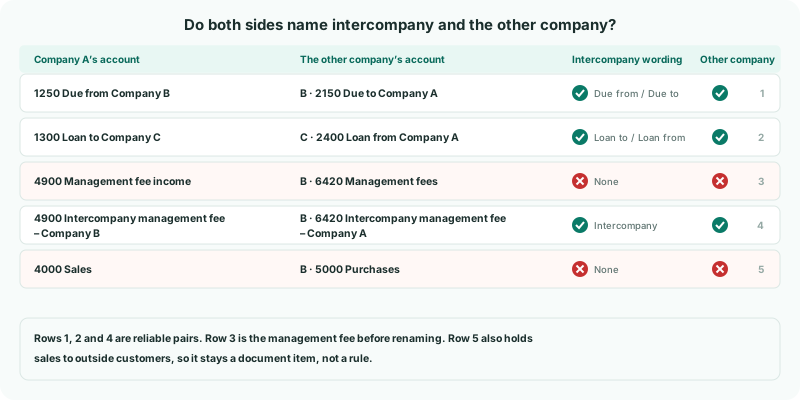
Due from / Due to and Loan to / Loan from pass on their own. The management fee accounts, 4900 Management fee income and 6420 Management fees, pass neither test, so Your Group renames them:
- In Company A’s accounting system, rename 4900 to Intercompany management fee – Company B.
- In Company B’s, rename 6420 to Intercompany management fee – Company A.
- Do the same for the royalty accounts on both sides.
- Reload Company A and Company B in BrizoConsol, so the new names arrive.
If you would rather keep the names short, put the same wording in the account’s description, where your accounting system has one: the description is read too. Or, if your companies code their accounts, recode the pair with mirrored codes such as A-IC-MF-B in Company A and B-IC-MF-A in Company B: the IC part passes the first test, and the mirrored codes the second.
4Check each account’s type
A pair must sit on opposite sides: an asset with a liability, or revenue with an expense. BrizoConsol takes the side from the account’s type in the company’s chart of accounts, not from its name. A Due to account set up as a current asset will not pair with a Due from, however it is named. Correct the type in that company’s books and reload it.
5Know which words suggest a type
When BrizoElim suggests a rule, it reads both accounts’ codes, names and types and files the rule under the first match in this list:
| If the accounts mention | Suggested type |
|---|---|
| receivable, payable, AR, AP, debtor, creditor | Trade Receivables / Payables |
| unrealised, unrealized, profit in inventory, UPI | Unrealised Profit |
| inventory, stock | Inventory Transfers |
| loan, advance, financing, borrow | Intercompany Loans |
| management, service fee, service charge, recharge, charge | Management Charges |
| dividend, distribution | Dividends |
| fixed asset, property, plant, equipment, PPE, asset transfer | Fixed Assets |
| income, expense, revenue, cost, sales | Other Income / Expenses |
| none of these | Other Eliminations |
The order matters. “Loan receivable from Company C” mentions receivable before anything else is checked, so it is suggested as Trade Receivables / Payables. Name loans “Loan to” and “Loan from” and they are suggested as Intercompany Loans. If the suggested type is switched off, the rule is filed under Other Eliminations. Either way, you can change a rule’s Intercompany Type when you edit it.
6Map each side to its own group account
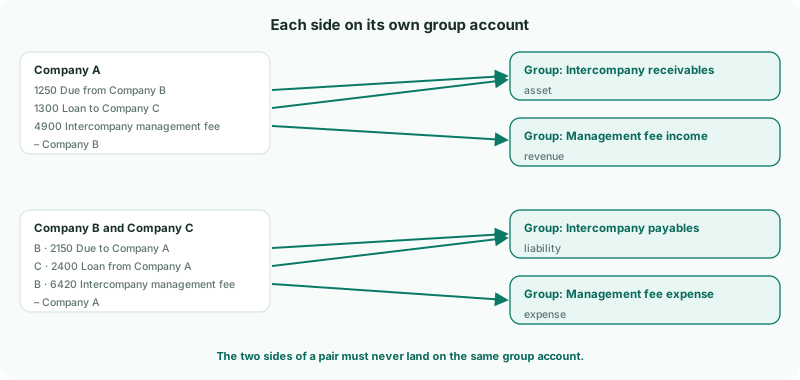
An elimination takes one side off one group account and the other side off another. If both sides are mapped to the same group account, there is nothing to take off: BrizoConsol refuses such an entry, and a rule built on it is skipped.
- Open Settings → Global Settings → Account Mapping, and choose Company A.
- Find 1250 Due from Company B. If a group account for intercompany receivables exists, choose it from the dropdown.
- If not, click the Create common account and map icon on the row. In Create And Map Account, enter an Account code with no spaces and the Account name Intercompany receivables. The Section is taken from 1250 and can’t be changed here. Click Create & Map: the account is created and the mapping saved at once.
- Map 1300 Loan to Company C to the same group account, and the management fee and royalty income to their group income accounts. Click Save.
- Choose Company B, and map 2150 Due to Company A to a group account for intercompany payables, and its management fee and royalty expense to group expense accounts. Click Save.
- Choose Company C, and map 2400 Loan from Company A to the intercompany payables account. Click Save.
Separate group accounts for intercompany are not required — the receivable and payable can go to your ordinary group accounts, as long as the two sides of every pair land on different ones. Separate accounts make it easy to see, in any report, that intercompany nets to nothing once eliminated.
Every intercompany account must be mapped. When you enter an elimination yourself, each company’s account list offers only its mapped accounts, because anything else would not reach the group’s figures.
Check
For each row of your plan, both accounts carry intercompany wording and point to each other by name or mirrored codes, and are mapped to two different group accounts. Account Mapping shows no account-type warning for them.
7If something goes wrong
| Both lines post to the same group account. An elimination cannot carry two legs on one account. | The two accounts in the entry are mapped to one group account. Map one side elsewhere, as in step 6. |
| A rule shows Leg 1: both sides post to the same group account | The same, for a rule. Fix the mapping and save the rule again. |
| No account of this entity is mapped to the group, so nothing entered here would appear in consolidation. | None of that company’s accounts is mapped yet. Map them in Account Mapping first. |
| The new account names don’t show in BrizoConsol | The company has not been reloaded since the rename. Reload it. |
| Duplicated code. Please use a unique account code. | The Common COA already has that code. Choose another, or map to the existing account from the dropdown. |
| BrizoElim suggests the wrong type for a pair | The names mention a word earlier in the list in step 5. Edit the rule and change its Intercompany Type, or rename the accounts. |
Want more detail? See the documentation