
Construction Groups · Track 1 · Tutorial 1 of 2
Set up intercompany types for a construction group
Before you clear anything, give each item that moves between your companies a type of its own, so it is filed and checked where your team expects it. This is the set-up that suits a construction group.
1Know what moves between your companies
A construction group usually has a holding company, contracting companies, a plant company that hires equipment to them, and project vehicles. These are the items that move between them:
| From | To | What |
|---|---|---|
| Holding company | Contracting companies | Management fees |
| Plant company | Contracting companies | Plant hire |
| Contracting company | Contracting company | Subcontract work, with retentions held back |
| Holding company | Project vehicles | Loans and interest |
| Contracting company | Group company | Building an asset the group keeps |
Each item should have a type of its own, so it is filed, listed and checked where your team expects it. Your group may not have all of them, or may have others: adjust the steps below to what your companies actually book.
2Switch types on and off
- Select the group, and open Settings → Global Settings → Intercompany Types.
- Click the switch on each type below that needs changing. Each switch is saved the moment you click it.
| Type | Change | For |
|---|---|---|
| Trade Receivables / Payables | Keep on | Unpaid plant hire, fees and subcontract invoices. |
| Sales / Purchases / Services | Keep on | The base for Subcontract Work. |
| Management Charges | Keep on | The holding company’s fees. |
| Intercompany Loans | Switch on | Funding for project vehicles. |
| Rental / Lease Adjustments | Switch on | The base for Plant Hire. |
| Fixed Assets | Switch on | Assets one group company builds for another. |
| Inventory Transfers | Switch off | Groups that don’t move stock between companies leave it empty. |
A new group starts with Trade Receivables / Payables, Sales / Purchases / Services, Inventory Transfers and Management Charges switched on. Other Eliminations is always on. See Switch on and add intercompany types.
3Add types of your own
- Click Add type.
- In Type name, enter Plant Hire.
- In Accounting treatment, choose Rental / Lease Adjustments, and click Save type.
- Add the others the same way.
| Type name | Accounting treatment | For |
|---|---|---|
| Plant Hire | Rental / Lease Adjustments | Hire charged by the plant company. Accepts Revenue, Direct Costs and Expense accounts, so hire income meets hire cost. |
| Subcontract Work | Sales / Purchases / Services | Work one contracting company does for another on a project. |
| Retentions | Trade Receivables / Payables | Retentions held back on subcontract payments, kept apart from ordinary unpaid invoices. |
The accounting treatment decides how the type behaves and which accounts its entries accept. A type of your own is in the menu only while the built-in type it works like is switched on.
4Arrange the menu
- Click Manage menu.
- For each group below, enter its Group name and click Add group.
- Drag each type onto its group, and click Save menu.
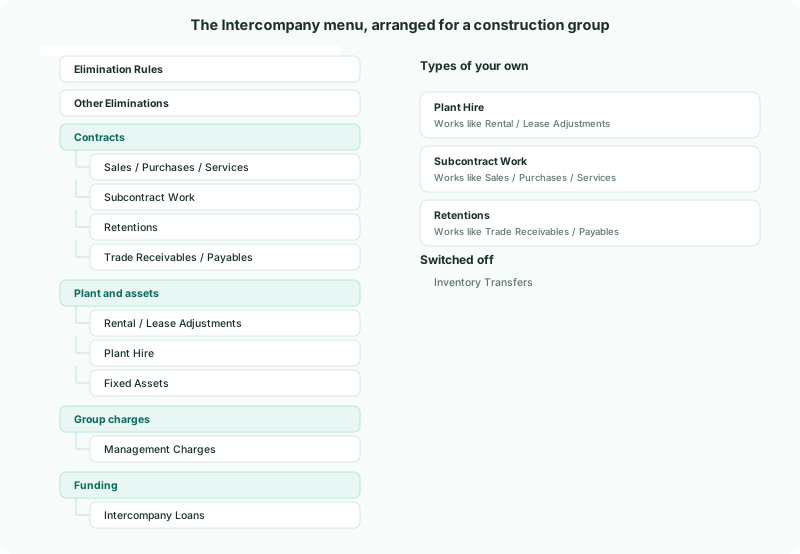
| Group | Types in it |
|---|---|
| Contracts | Sales / Purchases / Services, Subcontract Work, Retentions, Trade Receivables / Payables |
| Plant and assets | Rental / Lease Adjustments, Plant Hire, Fixed Assets |
| Group charges | Management Charges |
| Funding | Intercompany Loans |
See Arrange the Intercompany menu for moving, renaming and removing groups.
Check
Intercompany in the sidebar shows the groups above, and each type of your own is listed on Intercompany Types with Kind Custom and status Active.
5If something goes wrong
| A type of your own isn’t in the menu | The built-in type it works like is switched off. Switch it on. |
|---|---|
| … cannot be used in this elimination type. | The type’s accounting treatment doesn’t accept that account. Check the table in Switch on and add intercompany types, and choose the treatment whose accounts fit. |
| The arrangement was lost | The dialog was closed without Save menu. Arrange it again and save. |
Want more detail? See the documentation