
Construction Groups · Track 3 · Tutorial 1 of 2
Bring an FRS 102 subsidiary onto the group’s policies
A UK subsidiary keeps its books under FRS 102, but the group’s statements follow the group’s IFRS policies. Where the two differ, post the difference once at group level, so the subsidiary’s own figures stay as its books are.
1Know what needs adjusting
Your Group reports under IFRS, in SGD. Company C, its UK contracting company, keeps its books in GBP under FRS 102. Its figures come into BrizoConsol as its books are; where FRS 102 and the group’s IFRS policies differ, you adjust at group level with a GAAP journal.
FRS 102’s amendments for periods from 1 January 2026 bring its lease and revenue models close to IFRS 16 and IFRS 15, so agree the remaining differences with your auditor. Two that often remain in a construction group:
| Item | Company C under FRS 102 | The group under IFRS |
|---|---|---|
| Goodwill on a trade Company C bought in January 2024 | Amortised over its useful life: 10 years. | Not amortised; tested for impairment every year (IAS 36). |
| Interest on the loan financing its new plant depot | Expensed, under its policy choice. | Capitalised while the depot is built, as a cost of a qualifying asset (IAS 23). |
Each adjustment is posted on the group, so Company C’s own figures and reports stay as its books are. Work the amounts out in SGD at the rates Company C’s figures are translated at. The figures below are illustrative.
2Open GAAP Journals
- Select Your Group, and open Adjustments → GAAP Journals. Keep the scenario on Actual.
- Click + Add a new journal entry.
GAAP Journals is in the menu once IFRS is enabled for the group, as in Switch on IFRS and classify equity. Start each Journal ID with the same prefix, such as IFRS-C-, so every adjustment for Company C can be found with one search.
3Reverse the goodwill amortisation
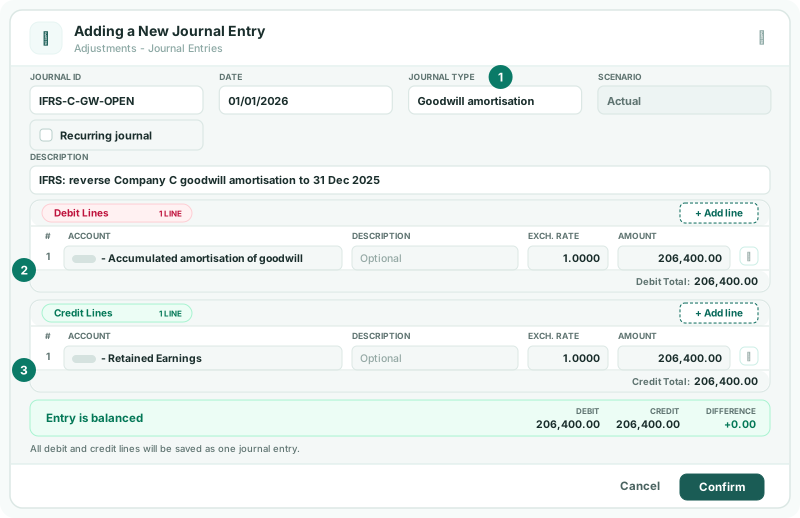
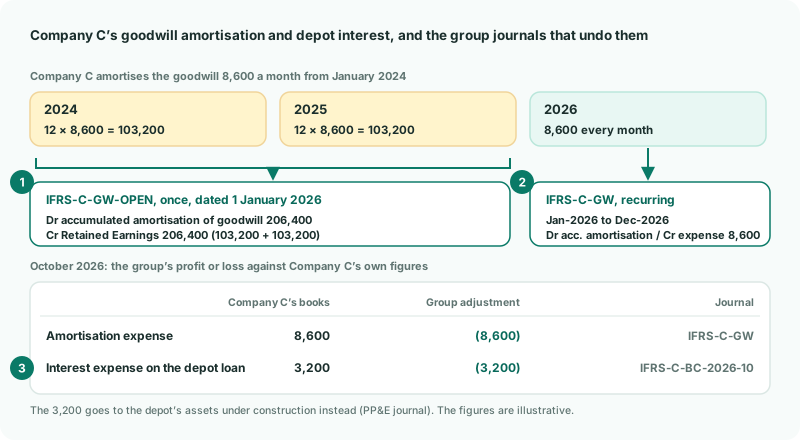
First, once, the amortisation Company C charged in 2024 and 2025, 206,400 in SGD:
- Enter the Journal ID IFRS-C-GW-OPEN, the date 1 January 2026, the Journal Type Goodwill amortisation, and a Description such as IFRS: reverse Company C goodwill amortisation to 31 Dec 2025.
- Debit Company C’s accumulated amortisation of goodwill 206,400, credit Retained Earnings 206,400, and click Confirm.
Then every month, the month’s amortisation, 8,600:
- Add a journal with the Journal ID IFRS-C-GW, type Goodwill amortisation, and its description.
- Tick Recurring journal, and choose Jan-2026 as Start Period and Dec-2026 as End Period.
- Debit the accumulated amortisation 8,600, credit the amortisation expense 8,600, and click Confirm.
Test the goodwill for impairment at the year end. An impairment loss is a journal of type Impairment.
4Capitalise the borrowing costs
While the depot is being built, Company C expenses the interest on the loan that finances it: 3,200 a month in SGD.
- Add a journal for each month: Journal ID IFRS-C-BC-2026-10, the month end, type PP&E, and a description.
- Debit the depot’s assets under construction account 3,200, credit Interest Expense 3,200, and click Confirm.
Use a recurring journal instead when the interest is the same each month. Stop when the depot is substantially ready for use. From then, depreciate the capitalised interest with the depot: a monthly PP&E journal debiting depreciation and crediting accumulated depreciation.
5Check the adjustments
- On GAAP Journals, type IFRS-C- in the search box.
- Open Reports → All Reports → Consolidated Statement of Profit or Loss for 2026.
Check
The search lists only Company C’s adjustments, the recurring ones once for each month. For October, the group’s amortisation expense is 8,600 lower and its interest expense 3,200 lower than Company C’s own figures give.
6If something goes wrong
| What you see | What to do |
|---|---|
| GAAP Journals isn’t under Adjustments, or GAAP Journals are only available when the group has more than one accounting standard enabled. | Enable IFRS for Your Group on the Accounting Standard page. |
| Journal ID already exists: … | Each Journal ID can be used once. Add the month, as in IFRS-C-BC-2026-10. |
| Duplicated account is not allowed in journal lines. | The same account is on two lines. Combine them into one. |
| Recurring journal end period must be on or after the start period. | Choose an End Period after the Start Period. |
| One or more selected periods are locked. | The month is locked. Ask an administrator to unlock it, or post in an open month. |
Want more detail? See the documentation