
SFRS Groups · Track 3 · Tutorial 4 of 4
Read the statement of cash flows
Available on ProPremium
The SFRS cash flow statement explains the year’s change in the group’s cash. Operating cash flow is worked out from profit; investing and financing flows come from the accounts you classified; and the statement ends at the bank balance.
1Know how the statement is built
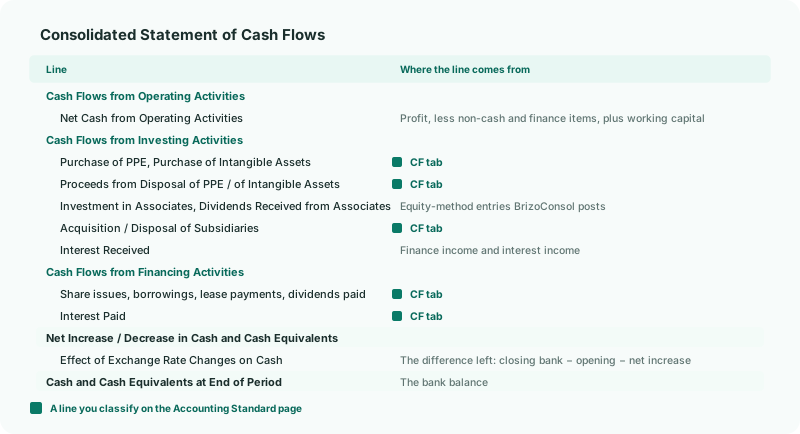
| Operating activities | The indirect method. Net profit, less the share of profit of associates and the gain or loss on disposal, with finance costs added back and finance income taken out, plus depreciation, plus the change in receivables, inventory, other current assets, payables and other current liabilities. |
|---|---|
| Investing activities | The year’s movement on the accounts classified on each line, the cash paid for and dividends received from associates, and Interest Received — the year’s finance and interest income. |
| Financing activities | The movement on the accounts classified on each line, including Interest Paid. |
| Effect of Exchange Rate Changes on Cash | What is left: the bank balance at the end, less the balance at the start, less the net increase from the three sections. |
2Read each section
- Select Your Group, and open Reports → All Reports → Consolidated Statement of Cash Flows for 2026.
| Interest | SFRS lets a group choose where interest goes. This statement shows interest received under investing and interest paid under financing, and takes both out of operating cash flow. |
|---|---|
| Associates | Investment in Associates is the cash paid for an associate less proceeds from selling part of it, and Dividends Received from Associates the dividends it paid the group. Both come from the entries BrizoConsol posts — see Account for associates and joint ventures. |
| Share issues and dividends | An equity account keeps its equity line and can also be given a cash flow line. For a share issue, put 3000 Share Capital on Proceeds from Issue of Share Capital as well as on Share Capital. Put the account dividends are recorded in on Dividends Paid to Owners of the Company. |
An account can be on one cash flow line, and on one Equity or P&L line.
3Check the statement ends at the bank
- Open the group’s Balance Sheet at the end of the same period.
Check
Cash and Cash Equivalents at End of Period equals the bank balance — 1,402,350 for Your Group. Effect of Exchange Rate Changes on Cash is small, -3,250, which fits translating Company B’s and Company C’s cash.
The end of period always equals the bank balance, because the effect line takes up whatever the three sections don’t explain. So check the effect line, not the end: a large one means a movement isn’t on any line.
4If something goes wrong
| Effect of Exchange Rate Changes on Cash is large | A cash movement isn’t on any line — often a new loan, an asset bought into an account that isn’t classified, a share issue or a dividend. Find the account that moved and classify it on the CF tab. |
| Proceeds from Issue of Share Capital is empty after a share issue | Share Capital isn’t on the cash flow line. Add it on the CF tab; it keeps its equity line. |
| The same account cannot be used for multiple classifications within the same standard. | The account is on two cash flow lines, or on two Equity or P&L lines. Keep one of each. |
| Dividends from an associate are missing | BrizoConsol finds the associate’s dividends by the account’s name, such as Dividends Paid. Check what the account is called in the associate’s books. |
Want more detail? See the documentation