
Local GAAP Groups · Track 3 · Tutorial 1 of 4
Read the statement of financial position and profit and loss
Available on ProPremium
The Local GAAP statement of financial position and profit and loss show the same consolidated figures as the Base Balance Sheet and Profit & Loss, in a summarised layout. Most lines come from the accounts’ types; the equity lines and the share of profit of associates come from the classifications you set.
1Know where the lines come from
| From the account types | Assets, liabilities, revenue, cost of sales, operating expenses, finance income and costs, and tax. Each line adds up the accounts of one or more types in the Common COA, such as Bank or Non Current Liability. Nothing to classify. |
|---|---|
| From your classifications | Every equity line, and Share of Profit of Associates. Each reads the accounts you put on it on the Accounting Standard page. |
| Worked out | Subtotals, and the lines that are the rest of a type: Other Non-Current Assets and Other Income. |
The figures are the one consolidation, so the Local GAAP statements agree with the Base reports. Where they don’t, a classification is missing.
2Read the statement of financial position
- Select Your Group, and open Reports → All Reports → Consolidated Statement of Financial Position.
- Choose the month. The statement shows the balances at the end of it.
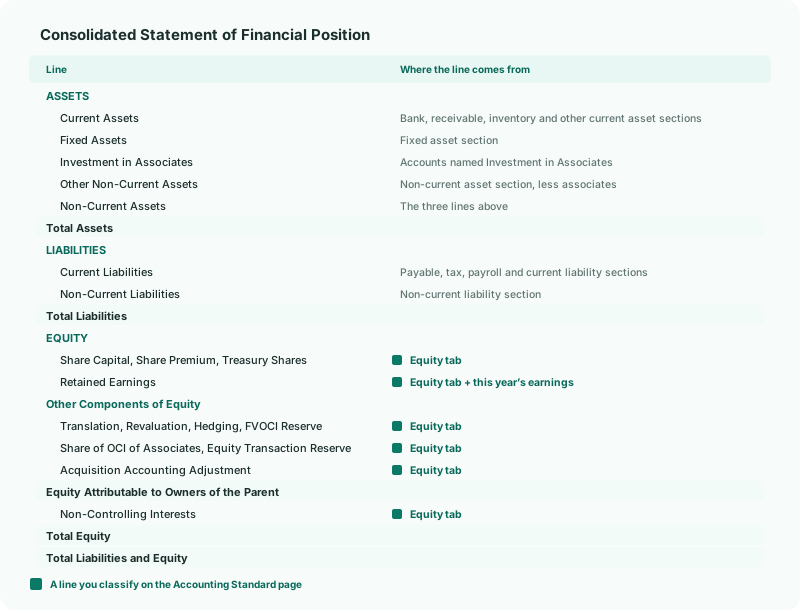
| Current Assets, Current Liabilities | One line each. Current Assets adds bank, receivables, inventory and other current assets; Current Liabilities adds payables, tax payable, payroll payable and other current liabilities. |
|---|---|
| Non-Current Assets | Fixed Assets, Investment in Associates and Other Non-Current Assets added together. |
| Investment in Associates | The accounts named Investment in Associates or Investment in Joint Ventures, taken out of Other Non-Current Assets. See Account for associates and joint ventures. |
| Treasury Shares | The accounts on the Treasury Shares line — the company’s own shares it has bought back. They reduce equity, so they are shown as a deduction. |
| Retained Earnings | The accounts on the Retained Earnings line plus the year’s profit so far that belongs to the owners. The NCI’s share of the profit is in Non-Controlling Interests. |
| Other Components of Equity | The reserves, each from its line on the Equity tab: Translation Reserve, Revaluation Reserve, Hedging Reserve, FVOCI Reserve, Share of OCI of Associates and Equity Transaction Reserve. |
| Acquisition Accounting Adjustment | The accounts on the Acquisition Accounting Adjustment line, such as the account your acquisition entries post to. |
| Equity Attributable to Owners of the Parent | Every equity line above added together: the owners’ equity. |
| Non-Controlling Interests | The accounts on the Non-Controlling Interest line. Accounts created in Posting accounts are classified from their names, so NCI Net Assets, NCI Share of Profit, NCI Share of CTA and NCI Share of Other Reserves all land here. |
3Read the profit and loss
- Open Reports → All Reports → Consolidated Statement of Profit or Loss for 2026.
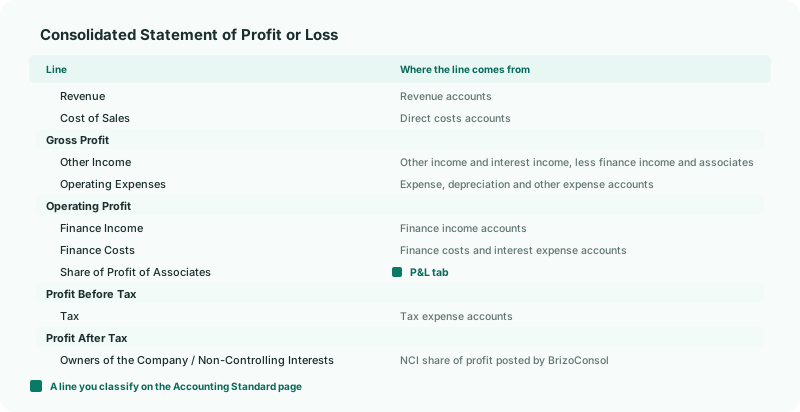
| Other Income | The other income and interest income accounts, less finance income and the share of profit of associates, which have lines of their own. Interest income is part of operating profit here, not of Finance Income. |
|---|---|
| Operating Expenses | The expense, depreciation and other expense accounts, on one line. Finance costs are typed Other Expense too, but they stay on Finance Costs. |
| Finance Income, Finance Costs | The finance income accounts; and the finance costs and interest expense accounts. |
| Share of Profit of Associates | After finance costs, just above Profit Before Tax. |
| Owners of the Company, Non-Controlling Interests | The NCI’s share is the share of profit BrizoConsol posts for each subsidiary with an NCI; the owners’ share is the rest of Profit After Tax. |
4Check against the Base reports
- Open the group’s Balance Sheet and Profit & Loss for the same month and year.
Check
On the Local GAAP statement of financial position, Total Assets equals Total Liabilities and Equity, and Total Equity equals the Balance Sheet’s equity — 1,817,100 for Your Group. Profit After Tax on the Local GAAP profit and loss equals Net Profit on Profit & Loss.
5If something goes wrong
| Total Equity is lower than the Balance Sheet, and the statement doesn’t balance | An equity account isn’t classified. Put it on its line on the Equity tab — see Switch on Local GAAP and classify equity. |
| An amount is on the wrong line | The account’s type in the Common COA is wrong. Change the type; the line follows it. |
| Investment in Associates is empty, but the group has an associate | The investment account’s name wasn’t recognised. Create it from Posting accounts on the Ownership page, named Investment in Associates. |
| The Local GAAP statements aren’t in All Reports | Select the group, not a company. Local GAAP must be enabled and saved for it. |
Want more detail? See the documentation