
Foreign Currency · Track 4 · Tutorial 2 of 3
Read the translation effect in the cash flow
A foreign company’s cash is worth more or less in the group currency when the rate moves, without any cash moving. The cash flow shows that change on its own line, between the year’s cash flows and the closing cash.
1Know how the line is worked out
Every cash flow statement in BrizoConsol ends the same way:
| Opening cash | The bank balances at the end of the previous period, at that date’s closing rates. |
|---|---|
| Net cash flow | The operating, investing and financing sections. |
| Effect of exchange rate changes | On the Cashflow report: the change in opening cash from the rate moving, plus the period’s cash movements at the closing rate less the same movements at the average rate. On a standard’s statement: closing cash less opening cash less the net cash flow. |
| Closing cash | The bank balances now, at this month’s closing rates. |
The statement always ends at the bank balance on the balance sheet. On a standard’s statement, the effect line is what is left once the three sections are counted. The Cashflow report works it out from the bank, and shows anything the sections miss as Cash Flow Reconciliation Difference, under Cash FX Reconciliation. It is called Effect of Exchange Rate Changes on Cash on the Cashflow report and the IFRS and SFRS statements, and has a similar name on the others.
2Work out what to expect
Company B held AUD 200,000 in the bank all of 2026, and nothing moved through it. The rate went from 1.1000 AUD to 1 SGD at the start of the year to 1.1200 in October.
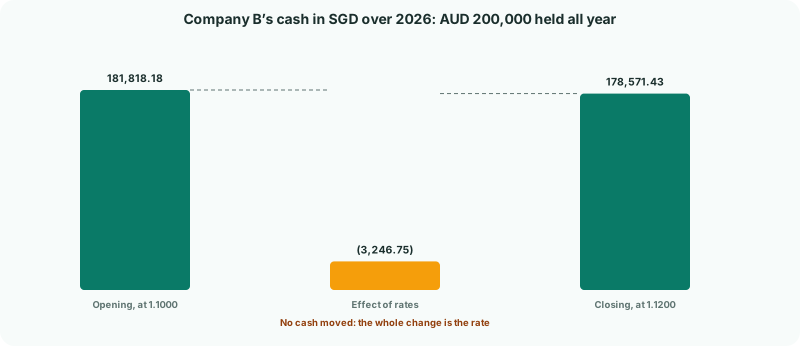
- For each foreign company, take its cash at the start of the period, in its own currency, at the opening and the closing rate: 200,000 ÷ 1.1200 − 200,000 ÷ 1.1000 = (3,246.75).
- For cash that came in or went out during the period, add the difference between the closing rate and the average rate it was translated at.
- Add the companies up. That is roughly what the line should show.
3Read the line
- Select Your Group, and open Reports → Cashflow, or your standard’s Consolidated Cashflow, for Oct-2026, year to date.
- Compare Effect of Exchange Rate Changes on Cash with what you worked out.
Check
The line is close to your estimate, and the closing cash equals the bank total on the Balance Sheet.
A group whose companies all keep their books in the group currency should show nothing, or almost nothing, on this line.
4If something goes wrong
| The line is much larger than expected | On a standard’s cash flow, a movement that isn’t on any line falls into the effect line: classify the account on the Accounting Standard page, as in that standard’s Classify tutorial. On the Cashflow report, such a movement shows in Cash Flow Reconciliation Difference instead. |
|---|---|
| The line moves in a group with no foreign companies | On a standard’s cash flow: an unclassified movement, or a balance sheet account the statement doesn’t read. |
| The effect is large in one month only | A rate is missing or wrong for that month. Check Exchange Rates, as in Manage closing and average exchange rates. |
Want more detail? See the documentation