
E-commerce Groups · Track 2 · Tutorial 2 of 2
Align revenue recognition across companies
When one trading company recognises revenue on payment and another on delivery, group revenue mixes two policies. The group must report on one, so the company that differs is adjusted at group level.
1Know what has to match
The group reports one revenue figure, so every company has to recognise the same kind of sale in the same way. IFRS 10 requires consolidated statements to use uniform accounting policies for like transactions (paragraph 19), and adjustments where a company’s own statements use different ones (paragraph B87).
In an e-commerce group, two policies often differ between trading companies:
| Policy | The group’s treatment | The company that differs |
|---|---|---|
| When an online sale is revenue | Under IFRS 15, when control of the goods passes to the customer. Your Group’s policy is on delivery. | Trading company B records revenue when the order is paid, before the goods are sent. |
| Expected returns | Revenue net of the returns expected, with a refund liability and an asset for the goods expected back (IFRS 15, B20–B27). | Trading company B records returns only when goods come back. |
Decide first where the difference belongs. If the company’s own books are wrong under its own standard, correct them in its accounting system and reload the month. If its books are right for the company but differ from the group’s policy, adjust at group level with a journal, as below.
2Work out the adjustments
At 31 October, from trading company B’s order and returns reports:
| Paid, not yet delivered | 18,000 of orders recorded as revenue. Under the group’s policy, the payments are a liability until delivery. |
|---|---|
| Returns expected | 6,000 of October sales are expected to come back, at a cost of 3,500. |
If trading company B’s books also took the undelivered goods out of stock, adjust its cost of sales and stock too. Work the amounts out in the group currency.
3Post the month-end journal
- Select Your Group, and open Adjustments → Consolidation Journals. Keep the scenario on Actual and move to Oct-2026.
- Click Add a new journal entry.
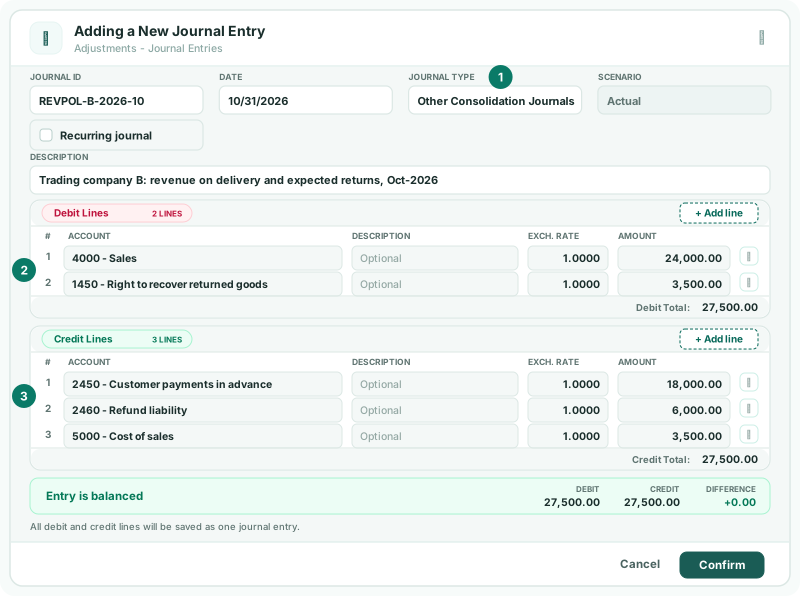
- Enter the Journal ID REVPOL-B-2026-10, keep the Date 31 October 2026, keep Journal Type Other Consolidation Journals, and enter the Description Trading company B: revenue on delivery and expected returns, Oct-2026.
- Enter the lines below, keep Exch. Rate at 1.0000, and click Confirm when it shows Entry is balanced.
| Line | Why |
|---|---|
| Debit 4000 Sales 24,000 | Takes out 18,000 of revenue for goods not yet delivered, and 6,000 on sales expected to come back. |
| Credit 2450 Customer payments in advance 18,000 | The payments for undelivered orders, a liability until delivery. |
| Credit 2460 Refund liability 6,000 | What the group expects to refund. |
| Debit 1450 Right to recover returned goods 3,500, credit 5000 Cost of sales 3,500 | The goods expected back, at cost. |
Lines use your Common COA accounts, and each account can be on one line only. The account codes here are examples: use your group’s own.
4Reverse it the next month
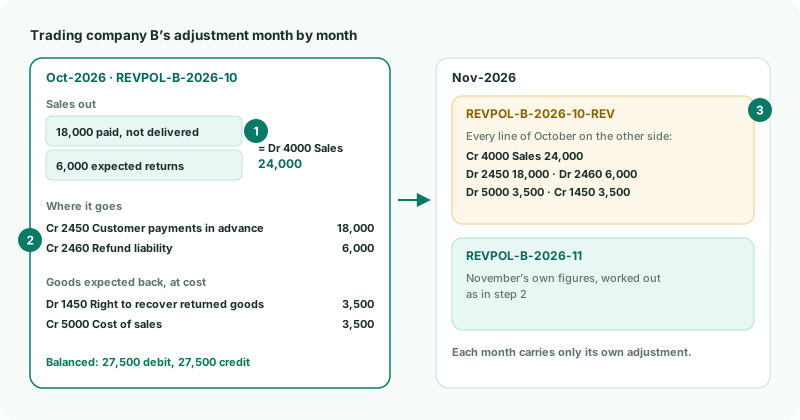
In November, the October orders are delivered and the returns come in through trading company B’s books. So October’s adjustment has to come out again, or it would be counted twice.
- In Nov-2026, add REVPOL-B-2026-10-REV with every line of October’s journal on the other side.
- Add REVPOL-B-2026-11 with November’s figures, worked out as in step 2.
Each month then carries only that month’s adjustment, and the balance sheet shows the liability for the orders and returns open at that month end. A Recurring journal repeats the same amount every month, so it doesn’t suit an adjustment that changes.
5Check the month
- Open Review → Elim. & Journals Report for Oct-2026, and find REVPOL-B-2026-10.
- Open Reports → Profit & Loss for Oct-2026 with Show Entities on.
Check
The journal is in Elims/Adj, not in trading company B’s column: Sales in Elims/Adj includes (24,000) from it, and trading company B’s own figures still match its books. On the Balance Sheet, the group shows 18,000 of customer payments in advance and a 6,000 refund liability.
6If something goes wrong
| What you see | What to do |
|---|---|
| Debit and Credit totals must be balanced before saving. | The two sides differ. Check the amounts until the entry is balanced. |
| Duplicated account is not allowed in journal lines. | The same account is on two lines. Combine them into one. |
| Journal ID already exists: … | Each Journal ID can be used once. Add the month, as in REVPOL-B-2026-11. |
| One or more selected periods are locked. | The month is locked. Ask an administrator to unlock it, or post in an open month. |
| Revenue falls twice in November | October’s journal wasn’t reversed in November. Add the reversal. |
Want more detail? See the documentation